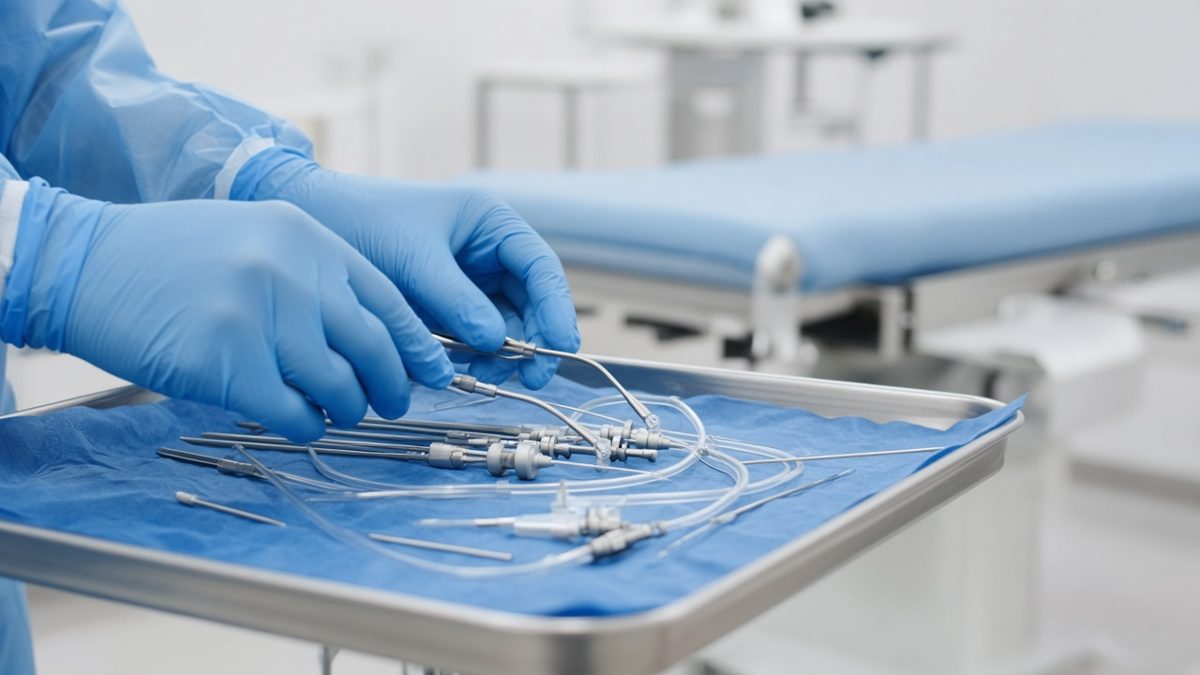
A practical method for reading the treatment record, opening the right code family, choosing the tier, and building each claim line for a radiation oncology brachytherapy course.
Most brachytherapy coding errors start before anyone opens a code book. The coder works from the charge ticket, the applicator name, or last month’s template instead of the treatment record. Here is how to code brachytherapy correctly. The thesis of this post is simple: code a brachytherapy course from five facts in the treatment record, in a fixed order: source type, dose rate, technique, count, and who did what, and where. Once you have those five facts, the code family picks itself, the tier follows the count, and the claim lines fall into place.
Brachytherapy: radiation delivered by placing a sealed source inside or next to the treatment site.
HDR (high dose rate): delivery above 12 Gy per hour at the prescription point, given by a remote afterloader in short sessions. HDR is always temporary.
LDR (low dose rate): delivery at or below 2 Gy per hour at the prescription point. LDR sources may be temporary or permanent, such as prostate seeds.
eBT (electronic brachytherapy): a miniature x-ray source used in place of a radioactive isotope.
Channel: one afterloader catheter or applicator path that the HDR source travels through.
NCCI (National Correct Coding Initiative): the CMS program of edits and policy that blocks code pairs that should not be billed together.
MUE (Medically Unlikely Edit): the CMS limit on how many units of a code one provider can bill for one patient on one date of service.
PC / TC: the professional and technical components of a service, billed with modifiers 26 and TC.
The HDR and LDR dose-rate thresholds come from ASTRO’s brachytherapy model policy, which also explains that LDR complexity is counted by sources and HDR complexity is counted by channels.
Each applicator insertion is documented, and that record drives the code.
Step 1: Pull five facts from the treatment record
Before you pick any code, open the brachytherapy treatment record, the physics plan, and the procedure note. Do not code from the scheduling slot or the charge sheet. Write down these facts for every treatment date:
Source type. Was the source a radionuclide (for example, iridium-192, iodine-125, palladium-103, or cesium-131) or an electronic x-ray source? This one fact splits the course into two different code sets.
Dose rate. HDR or LDR. The prescription and the treatment record will show it.
Technique. Interstitial (source inside tissue through needles or catheters), intracavitary (source inside a body cavity, such as the uterus or vagina), surface (skin or eye), or infusion or instillation of a radioactive solution.
The count. For HDR, the number of channels actually treated in that fraction. For LDR, the number of sources applied. Count from the treatment record, not from the applicator’s product name.
Who did what, and where. Who inserted the applicator, needles, or catheters? Who applied the source? Was the service in a hospital outpatient department or a freestanding center? Was external beam radiation therapy (EBRT) part of the same course?
Also capture the time of each HDR fraction when there are two in one day, the isodose plan and its date, any sedation record, and the diagnosis documented for the encounter. For hospital LDR implants, capture the number of sources implanted and the number ordered but not implanted.
Why this order matters. A coder who starts from “tandem and ovoids” might reach for an intracavitary LDR code. A coder who starts from source type and dose rate sees “radionuclide, HDR, intracavitary, 3 channels” and lands on the right code the first time.
Step 2: Open the right code family
Use the facts from Step 1 to open one family. Work down this list and stop at the first match.
First question: electronic or radionuclide?
Electronic source, skin: this no longer uses a brachytherapy code. Category III code 0394T was deleted, and ASTRO’s coding FAQ says skin eBT now goes to the surface radiation codes 77436 and 77437. In Washington, Noridian LCD L40176 addresses superficial radiation therapy for nonmelanoma skin cancer. On the Noridian JF active LCD list it is paired with codes that include 77436, 77437, and 77439. Check that LCD before billing skin surface radiation for a Medicare patient.
Electronic source, interstitial or intracavitary: 0395T, HDR electronic brachytherapy. ASTRO notes that 0395T includes basic dosimetry, and that the radionuclide brachytherapy, isodose plan, and management codes are not reported in addition to it. It is contractor priced on the 2026 Physician Fee Schedule (PFS).
Radionuclide source: go to the next question.
Second question: HDR or LDR?
HDR radionuclide (remote afterloader):
Skin surface: 77767 or 77768.
Interstitial or intracavitary: 77770, 77771, or 77772.
LDR radionuclide:
Intracavitary application: 77761, 77762, or 77763.
Interstitial application, complex: 77778. It is active on the 2026 PFS file (short descriptor “Apply interstit radiat compl,” which does not state a source count). ASTRO’s brachytherapy model policy (updated January 20, 2026) describes it as more than 10 interstitial sources.
Surface application: 77789. ASTRO’s FAQ gives strontium-90 eye treatment as an example.
Infusion or instillation of a radioelement solution: 77750.
Nothing fits: 77799, unlisted clinical brachytherapy. It is contractor priced, so send the record with the claim.
Third question: what else belongs to this course?
Brachytherapy is never one code. Open these families as the record supports them:
Clinical treatment planning: 77261, 77262, or 77263. These are professional-only codes, so no 26 or TC modifier.
Brachytherapy isodose plan: 77316, 77317, or 77318.
Applicator, needle, or catheter insertion: a surgical code from the anatomic section, such as 57155 (uterine tandem and/or vaginal ovoids), 57156 (vaginal afterloading apparatus), 55875 (transperineal needles or catheters into the prostate), 55920 (needles or catheters into pelvic organs or genitalia, except prostate), 19296–19298 (breast), 20555 (muscle or soft tissue), 41019 (head and neck), or 31643 (bronchoscopic catheter placement).
Imaging guidance, when performed and documented: 76965 for ultrasound guidance of interstitial radioelement application.
Hospital sources: the source-specific C-codes on the hospital claim, such as C1717 for HDR iridium-192.
Codes that should make you stop and check before they go on the claim: 77300 (basic dosimetry), 77790 (source supervision, handling, and loading), 77427 (weekly treatment management), and 77336 (continuing medical physics). Most of the time they are already included in the brachytherapy code. The bundling post explains each one.
Step 3: Choose the tier from the count
Tiering is where the five facts pay off. Each family has its own counting rule.
A note on where the counts come from. The channel and source thresholds below come from the longer code descriptions in ASTRO’s brachytherapy model policy (updated January 20, 2026). The CMS short descriptors on the 2026 PFS file do not spell them out. For 77770, 77771, and 77772 the short descriptor is the same: “Hdr rdncl ntrstl/icav brchtx.” Other short descriptors in these families say “simple,” “intermediate,” or “complex,” or name the technique. The codes themselves are active on the 2026 file, and the thresholds below match ASTRO’s January 2026 update. Still, confirm them against your current CPT book.
HDR interstitial or intracavitary (77770–77772)
77770: 1 channel.
77771: 2 to 12 channels.
77772: more than 12 channels.
Count the channels from that fraction’s treatment record. If the record is unclear, ask physics before you code. If the channel count changes between fractions, the code can change between fractions too.
HDR skin surface (77767–77768)
77767: lesion diameter up to 2.0 cm, or 1 channel.
77768: lesion diameter over 2.0 cm and 2 or more channels, or multiple lesions.
LDR intracavitary (77761–77763)
77761: 1 to 4 sources.
77762: 5 to 10 sources.
77763: more than 10 sources.
Brachytherapy isodose plan (77316–77318)
77316: 1 to 4 sources, or 1 HDR channel.
77317: 5 to 10 sources, or remote afterloading brachytherapy, 2 to 12. That model-policy line does not repeat the word “channels”; 77316 says one channel and 77318 says more than 12 channels.
77318: more than 10 sources, or more than 12 HDR channels.
Two tips. First, the plan tier and the delivery tier should usually agree. A 3-channel HDR fraction with a 77318 plan is a mismatch that deserves a second look. Second, one unit of an isodose plan includes dose calculations at multiple points, according to NCCI, so do not add units for extra calculation points.
Clinical treatment planning (77261–77263)
This tier is a physician judgment about the whole course, not a count. Code it from the physician’s planning note, which should describe the targets, the modalities, and why the plan is simple, intermediate, or complex.
Step 4: Check what the tier already includes
This step is a quick filter, not a full bundling review. Before you build the claim, strike out the services the brachytherapy code already pays for. One sentence each, with detail in the bundling post:
Basic dosimetry (77300): NCCI says it is integral to 77767–77772 and 77778. ASTRO’s FAQ also says not to bill it with 77316–77318 and 77770–77772.
Source handling (77790): NCCI says it is not separately reportable with brachytherapy codes such as 77770–77772 and 77778. ASTRO’s model policy quotes 77778 as including supervision, handling, and loading of the radiation source. ASTRO’s brachytherapy FAQ does allow 77790 with HDR “if the work is performed (gynecologic cases such as cylinder or tandem and ovoid).” The NCCI edits still bundle it with 77770–77772 and 77778, so follow NCCI.
Weekly management and physics (77427, 77431, 77336): NCCI includes them in brachytherapy, except for the external beam portion of a combined course. Under the multi-step exception, 77336 may be separately reportable with the brachytherapy.
Follow-up visits: 77750 and 77761–77763 carry a 90-day global on the 2026 PFS file.
Units per day: check the MUE for every line before release. Twice-daily partial breast HDR, which NCCI recognizes, is the common case where two units on one date can be correct.
Build the claim one line at a time, checking each against the tier rules.
Step 5: Build the claim line by line
Here is the order we use. It matches how the course happened, which makes the claim easier to defend.
The professional claim
Line order: list the services in clinical order on each date: insertion, then plan, then delivery.
Insertion code: bill it under the physician who performed the insertion. If the radiation oncologist placed the applicator, the insertion goes on the radiation oncologist’s claim. If a gynecologist, urologist, or surgeon placed it, it goes on theirs.
Isodose plan: one unit of 77316, 77317, or 77318 on the date the plan was done.
Delivery: one unit of the HDR or LDR code per fraction, with the tier from Step 3.
Modifier 26: add it to split-billable codes when the physician works in a hospital setting. On the 2026 PFS file, 77316–77318, 77761–77763, 77767–77768, 77770–77772, 77778, 77789, and 76965 have PC/TC indicator 1, so they accept 26 and TC. A blank modifier on those codes is the global service.
No modifier: professional-only codes (77261–77263) and physician-only surgical codes (such as 57155 and 55875) take neither 26 nor TC.
Technical-only codes: 77336 and 77370 are technical-only, so they never take 26 or TC.
Diagnosis: on insertion and implant encounters, list the malignancy first. The FY 2027 ICD-10-CM guidelines say Z51.0 should not be assigned for an encounter for insertion or implantation of radioactive elements. Z51.0 is for an encounter chiefly for external beam radiation, chemotherapy, or immunotherapy.
The hospital claim
Insertion code: many insertion codes, including 57155 and 55875, have status indicator J1 under the hospital outpatient payment system (OPPS). That means they anchor a comprehensive payment, and most other covered services on that claim are packaged into it.
Delivery and plan: report the same delivery and plan codes as the physician, without modifier 26.
Sources: report a separate source line with units as the source code’s long descriptor defines them. Sources are excluded from comprehensive packaging, but CMS pays them only when the hospital bills them. Seeds are billed per source, including each source in a strand.
77790: CMS lets the hospital either report 77790 charges separately or include them in the application code charge. Under OPPS, 77790 is packaged either way.
Washington payer note
For Medicare Part B in Washington, the contractor is Noridian JF, contract 02402. The Noridian JF active LCD list (last updated October 29, 2026) has no brachytherapy LCD, and the billing-and-coding articles list (last updated July 29, 2026) has no brachytherapy article. The Noridian JF radiation oncology page (last updated January 19, 2026) lists brachytherapy codes, including 0394T–0395T, and is education, not coverage policy. Do not use that page to revive 0394T. If Noridian JF publishes a brachytherapy LCD later, it controls.
Worked example: cervical cancer HDR tandem and ovoids after external beam
This example is an educational pattern, not a payment guarantee. Confirm current CMS, Noridian JF, and payer rules for every date of service.
The case. A patient with cervical cancer finishes a course of external beam radiation at a hospital outpatient department in Washington. The same radiation oncologist then delivers four HDR fractions, one per week, through a tandem-and-ovoid applicator. The radiation oncologist inserts the applicator at each fraction. The record documents a separate isodose plan for each insertion, reviewed by the physician. The patient is a Medicare beneficiary.
What the treatment record says
Source type: radionuclide, iridium-192.
Dose rate: HDR, remote afterloader.
Technique: intracavitary.
Count: each of the four fractions used 3 channels (the tandem and two ovoids). 57155 is the only insertion code, and it is only for the tandem and ovoids. This example does not add interstitial needles or 55920.
Who and where: the radiation oncologist performed the insertion and applied the source. Hospital outpatient setting. External beam came first, in the same course.
Which family and which tier
Radionuclide plus HDR plus intracavitary points to 77770–77772.
Three channels fall in the 2-to-12 range, so each fraction is 77771.
The isodose plan follows the same count: 77317 for each fraction.
The radiation oncologist’s claim, each HDR date
Line 1: 57155, 1 unit. No modifier. The radiation oncologist inserted the tandem and ovoids.
Line 2: 77317-26, 1 unit. Isodose plan, 3 channels. This line assumes a separately documented plan for that insertion. The MUE allows one unit per day.
Line 3: 77771-26, 1 unit. HDR delivery, 3 channels.
Diagnosis: the cervical malignancy, listed first. No Z51.0.
What stays off the radiation oncologist’s HDR lines
77300: NCCI treats it as integral to 77771. ASTRO’s FAQ also says not to bill it with isodose plans 77316–77318.
77790: not separately reportable with HDR delivery under NCCI.
77427 and 77336 for the HDR weeks: NCCI includes both in brachytherapy, except that with multi-step brachytherapy 77336 may be separately reportable. During the external beam weeks, those services are billed under the external beam rules. Our Radiation Oncology Billing in 2026 post covers that side.
A routine visit on the HDR day: NCCI allows an E/M service with 77770–77772 only when it is significant, separate, and distinct from treatment management. A routine pre-fraction check is unlikely to meet that bar.
Course-level lines
Clinical treatment planning: 77261, 77262, or 77263 as the physician’s planning note supports. Professional only, no modifier.
External beam planning: when external beam and brachytherapy are combined, ASTRO’s FAQ says to report the external beam isodose plan with 77295, 77301, 77306, or 77307, depending on the plan, and typically the brachytherapy plan with 77316–77318. The same FAQ says 77295 may also be reported for brachytherapy volume-implant dosimetry that rises to a 3-D plan.
The hospital’s claim, per HDR date
57155: status indicator J1. It anchors the comprehensive payment for that claim. ASTRO reports that tandem-and-ovoid insertions over multiple encounters can be reported per encounter.
77771 and 77317: no modifier. These sit under the J1 insertion’s comprehensive payment.
C1717: HDR iridium-192 source, with units as its descriptor defines. Sources are excluded from comprehensive packaging and pay separately.
77790: optional charge line or rolled into the application charge, per CMS. It is packaged.
Diagnosis: malignancy first. No Z51.0.
The self-check before release
Does each delivery tier match the channel count in that fraction’s afterloader record?
Does each plan tier match its delivery tier?
Is the malignancy listed first on every insertion date, with no Z51.0?
Are 77300, 77790, and HDR-week 77427 absent?
Does any code exceed its MUE on any date?
Is the hospital source line present, with units?
Common walkthrough mistakes
These are process errors, not policy errors. They show up when the team skips a step.
Coding from the applicator name. “Tandem and ring” does not tell you the tier. The channel count does.
Carrying one tier for the whole course. If a later fraction uses more channels, a template that copies the first fraction forward will miss the new tier. This example does not do that. Every fraction stays at 3 channels.
Mismatched plan and delivery tiers. If they disagree, one of them is probably wrong.
Coding eBT as radionuclide brachytherapy. Electronic sources have their own codes, and skin eBT now uses the surface radiation codes.
Using 77778 for intraoperative help. NCCI says the radiation oncologist reports 77778 only when they also apply the source at that encounter.
Defaulting Z51.0. Implant days list the cancer first.
Leaving the source off the hospital claim. No source line means no source payment.
Documentation checklist for each brachytherapy date
Source type and isotope, or an electronic source
HDR or LDR, and the technique
Channels treated (HDR) or sources applied (LDR) for that fraction
Session times when two HDR fractions happen on one day
Who inserted the applicator and who applied the source
The isodose plan, with its date and physician review
The diagnosis supporting the encounter, malignancy first
For hospital LDR implants: sources implanted, and any ordered but not implanted
Any separately documented problem, if an E/M is billed with 77770–77772
Frequently asked questions about how to code brachytherapy
How to code brachytherapy: what is the first step?
Pull five facts from the treatment record for each date: source type, dose rate, technique, count, and who did what, and where. Those facts open the right code family before you look at a single code.
How do I choose between 77770, 77771, and 77772?
Count the channels in that fraction’s treatment record. Under the thresholds in ASTRO’s model policy (updated January 20, 2026), 77770 is 1 channel, 77771 is 2 to 12 channels, and 77772 is more than 12 channels. Confirm the thresholds against your current CPT book.
Can I bill 77300 with an HDR fraction?
No. NCCI treats basic dosimetry (77300) as integral to 77767–77772 and 77778, and ASTRO’s FAQ also says not to bill it with 77316–77318 and 77770–77772.
Should the isodose plan tier match the delivery tier?
Usually, yes. A 3-channel HDR fraction with a 77318 plan is a mismatch that deserves a second look before the claim goes out.
Final takeaway
A brachytherapy course codes cleanly when the coder follows the record, not the template. Pull the source type, dose rate, technique, count, and who did what for every date. Let those facts open one code family. Let the count set the tier for delivery and planning. Strike out what the code already includes, then build the claim in clinical order. Do that every fraction, and tier changes, bundling problems, and diagnosis errors get caught before the claim leaves the building.
How ALH helps
ALH Billing Solutions works with radiation oncology practices on charge capture, coding review, and denial management. For brachytherapy, we audit treatment records against the codes billed and fix templates that carry one tier through a whole course. Questions? Email info@alhbillingsolutions.com or call 360-836-1413.
Subscribe to the newsletter
Get practical medical billing insights delivered to your inbox.